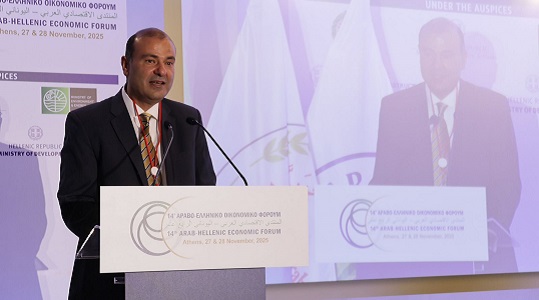
The Secretary-General of the Union of Arab Chambers, Dr. Khaled Hanafy, revealed during the opening of the 14th Arab–Hellenic Economic Forum — held under the title “Toward Closer Cooperation: Construction and Energy” in Athens, Greece, with the participation of delegations from 17 Arab countries representing company executives, business leaders, and officials, in addition to the presence of 180 Greek business leaders representing company heads and officials, along with several Arab ambassadors accredited in Greece, as well as the Chairman of the Suez Canal Authority, Admiral Osama Rabie — that the Union of Arab Chambers is launching four cooperation initiatives between the Arab world and Greece “The first initiative is based on building bridges between the Arab world and Greece for cooperation in reconstruction, as there are allocated amounts estimated between 450 and 500 billion USD for the Arab countries in need of reconstruction.”
He continued, “The second initiative aims to establish a corridor for green hydrogen and clean energy by connecting companies in the Arab world and Greece through coordination and consultation between the private sectors on both sides, particularly between the Union of Arab Chambers and the Arab–Hellenic Chamber.”
According to the Secretary-General of the Union of Arab Chambers, the third initiative focuses on establishing a center for artificial intelligence in energy and water. Studies indicate that artificial intelligence can contribute to reducing carbon emissions by 30 percent, and if we manage this file properly, we will be able to achieve the desired success in the reconstruction effort.
As for the fourth and final initiative proposed by the Union of Arab Chambers, according to Dr. Khaled Hanafy, it is based on a logistical alliance and the establishment of pivotal ports built on cooperation rather than competition, within a harmonized system in which Greece serves as a central hub in partnership with key ports in the Arab world — including the Suez Canal, whose Chairman, Admiral Osama Rabie, has been undertaking tremendous efforts, reflected recently during the crisis in the Red Sea, which contributed to reinforcing Egypt’s and the Arab world’s connectivity with all countries around the globe.
He added, “Given the growing economic and climate challenges facing the world, we need a partnership built on innovation and shared responsibility — one that places people and the environment at the heart of the economic equation and transforms challenges into opportunities for joint growth.”
During his remarks as coordinator and moderator of a session titled “Energy and Construction in the Age of Artificial Intelligence,” held as part of the “14th Arab–Hellenic Economic Forum,” the Secretary-General stressed: “We meet today at a pivotal moment where three forces shaping the future of the economy intersect: energy, construction, and digital transformation driven by artificial intelligence. Investments in AI technologies in the Middle East are expected to see significant growth, as the region stands at the forefront of benefiting from these technologies — particularly since the strategic adoption of AI, combined with enhanced climate resilience, could add up to 232 billion USD to the region’s GDP by 2035. Major energy companies in the Middle East have already begun implementing AI technologies to improve operational efficiency, amid growing concern over the increasing energy consumption resulting from the rapid expansion of data centers — a trend that will heavily influence future electricity demand.”
He added, “In the construction sector, artificial intelligence can reshape building design, cost, maintenance, and even energy consumption. Digital transformation in construction through AI opens new opportunities for partnership between Arab and Greek sectors, whether in infrastructure or in building smart and sustainable cities.”
He called for “the importance of leveraging Greece’s expertise and the capabilities of Arab countries to build a future cooperation model that contributes to green development and digitalization. From this standpoint, the public and private sectors in Greece and the Arab world should consider launching tangible initiatives and pilot projects in smart energy and construction — elevating the existing Arab–Greek relationship from its traditional framework of trade exchange to a strategic partnership that supports the achievement of shared aspirations.”
Source (Union of Arab Chambers)
